
You’ve finally decided to take your listening experience seriously, but then reality hits: your new high-impedance headphones sound quiet and lifeless when plugged straight into your laptop or phone. The problem isn’t your headphones—it’s the lack of power. A dedicated amplifier solves this, but the audio world is full of confusing specs, snake oil, and wildly expensive gear that makes budget shopping feel overwhelming. The good news is that you don’t need to spend a fortune to get clean, powerful sound. This guide walks you through exactly how to buy a Headphone Amplifier in Texas on a Budget, covering what specs actually matter, which features to prioritize, and where to find the best deals without getting ripped off.
Key Takeaways
- Focus on power output (mW) and impedance matching rather than price or brand name when choosing a budget amplifier.
- Portable amps under $100 are ideal for on-the-go listening, while desktop amps in the $100–$200 range offer significantly better value for home use.
- Texas-based buyers can save money by shopping local electronics retailers like Micro Center and Fry’s Electronics (where available), checking university surplus stores, and leveraging big-box store price-matching policies.
- A DAC (digital-to-analog converter) built into your amp is worth the extra cost if your primary source is a laptop, PC, or phone with a weak internal sound card.
- Avoid purchasing amplifiers with proprietary power supplies or non-standard connectors on a tight budget, as replacement cables and adapters can cost as much as the amp itself.
Understanding What a Headphone Amp Actually Does
A headphone amplifier takes a low-level audio signal from your source (like a phone, computer, or music player) and boosts it to a level that can properly drive your headphones. It doesn’t improve the quality of a poor source, but it does provide the voltage and current needed for headphones to reach their full dynamic range without distortion. If your headphones sound quiet at maximum volume, lack bass punch, or distort during complex passages, an amplifier is the missing link.
However, not every headphone needs an amp. Low-impedance, highly sensitive in-ear monitors (IEMs) and most consumer earbuds perform fine with a phone or laptop. The rule of thumb: if your headphones have an impedance above 80 ohms or sensitivity below 100 dB/mW, they will likely benefit from an amp. If you’re using a pair of 250-ohm studio headphones like the Beyerdynamic DT 990 Pro, an amp isn’t optional—it’s required for acceptable volume levels.
Power Output and Headphone Sensitivity
When comparing budget amplifiers, the most critical specification is power output, measured in milliwatts (mW). You need enough power to drive your specific headphones to a comfortable listening level (usually 85–95 dB) with headroom to spare. A general guideline:
- For IEMs and low-impedance headphones (16–32 ohms): 20–50 mW per channel is sufficient.
- For medium-impedance headphones (32–80 ohms): 50–150 mW per channel is a safe range.
- For high-impedance headphones (150–600 ohms): Look for at least 100 mW at 300 ohms, or 200+ mW at lower impedances.
Don’t fixate on raw wattage figures alone. Check the power rating at different impedance levels. An amp that outputs 100 mW at 32 ohms but only 2 mW at 300 ohms won’t drive demanding headphones well. Budget amps often advertise power at low impedances, which is misleading for high-impedance users.
Impedance and Damping Factor
Impedance matching matters more than most beginners realize. The rule is that your amplifier’s output impedance should be less than 1/8th of your headphone’s impedance. For example, if your headphones are 32 ohms, you want an amp with an output impedance below 4 ohms. If the output impedance is too high, you’ll get uneven frequency response—bass becomes bloated and treble becomes harsh. Most solid-state budget amps have output impedances under 2 ohms, making them safe for virtually all headphones. Tube amps, especially budget ones, tend to have higher output impedance, so pair them only with high-impedance headphones.
Portable vs. Desktop Amps: Which Should You Buy?
Your decision between portable and desktop amps depends entirely on where and how you listen. Let’s break down the trade-offs.
Portable Headphone Amplifiers (Under $100)
Portable amps are battery-powered, compact, and designed to pair with phones or DAPs (digital audio players). They’re great for commuting, office use, or anyone who wants better sound from a phone without upgrading their entire source. Popular budget options include the Fiio A3, Fiio Q1 Mark II, and the TempoTec Sonata HD II (a USB dongle DAC/amp).
Pros: Convenience, small footprint, often includes a built-in DAC.
Cons: Limited power for high-impedance headphones, battery life constraints, small volume knobs can be finicky.
For a budget portable amp, look for at least 10 hours of battery life, a dedicated volume wheel (not phone-controlled), and standard 3.5mm input/output jacks. Avoid amps with proprietary connectors that force you to buy special cables.
Desktop Headphone Amplifiers ($100–$200)
Desktop amps plug into a wall outlet and offer much more power, better components, and often a built-in DAC. They’re the sweet spot for budget-conscious audiophiles who listen primarily at a desk or home setup. The Schiit Magni+ and JDS Labs Atom Amp are the gold standards in this price range, both delivering about 2.4W at 32 ohms and 300mW at 300 ohms—enough for nearly all headphones.
Pros: High power output, better build quality, more connectivity options (RCA, XLR, optical/coaxial inputs with a DAC), future-proofing.
Cons: Not portable, takes up desk space, requires a power outlet.
If you listen at home 90% of the time, a desktop amp is the better investment. The extra power means you won’t need to upgrade even if you buy harder-to-drive headphones later.
Budget Buying Strategies Specific to Texas
Living in Texas offers some unique advantages for budget audio shopping. Beyond the obvious online retailers, you have physical stores that allow you to test gear and take advantage of open-box deals.
Local Electronics and Big-Box Retailers
Micro Center, with locations in Houston and Dallas, is a goldmine for budget audio. They stock Fiio, Schiit, and sometimes Topping gear, and their open-box sections often have amps at 10–20% off. Best Buy also carries occasional headphone amps, particularly in their Magnolia sections in larger Texas cities. Don’t overlook Guitar Center—they stock headphone amps for studio use, and their used gear section often has barely-used solid-state amps at significant discounts. Price-match policies at Best Buy and Target mean you can show them an online price from Amazon or B&H and get the same price in-store, avoiding shipping fees and wait times.
University and Military Surplus Stores
Texas is home to major universities (UT Austin, Texas A&M, University of Houston) and military bases (Fort Cavazos, Lackland AFB). Surplus stores near these institutions occasionally receive audio equipment from upgraded campus recording studios or base media centers. While you won’t find top-tier audiophile brands, you can find solid prosumer gear like Behringer or Mackie headphone distribution amps for under $30. It’s a long shot, but worth checking if you’re in those areas. Most of these units are rack-mountable, not designed for personal desktop use, so only consider this route if you need multiple headphone outputs.
Online Communities and Local Meetups
Texas has active audiophile communities, particularly in Austin and Dallas. Head-Fi hosts regional meetups, and local Facebook groups (like “DFW Audiophile Buy/Sell/Trade”) frequently have members selling used budget amps for less than half of MSRP. Buying used isn’t risky if you follow basic precautions: ask for proof of purchase, request a video of the amp working before payment, and meet in a public place to test. You can often find a JDS Atom or Schiit Magni for $60–$80 used, which is an incredible value for the performance.
Should You Buy a DAC and Amp Combo or Separates?
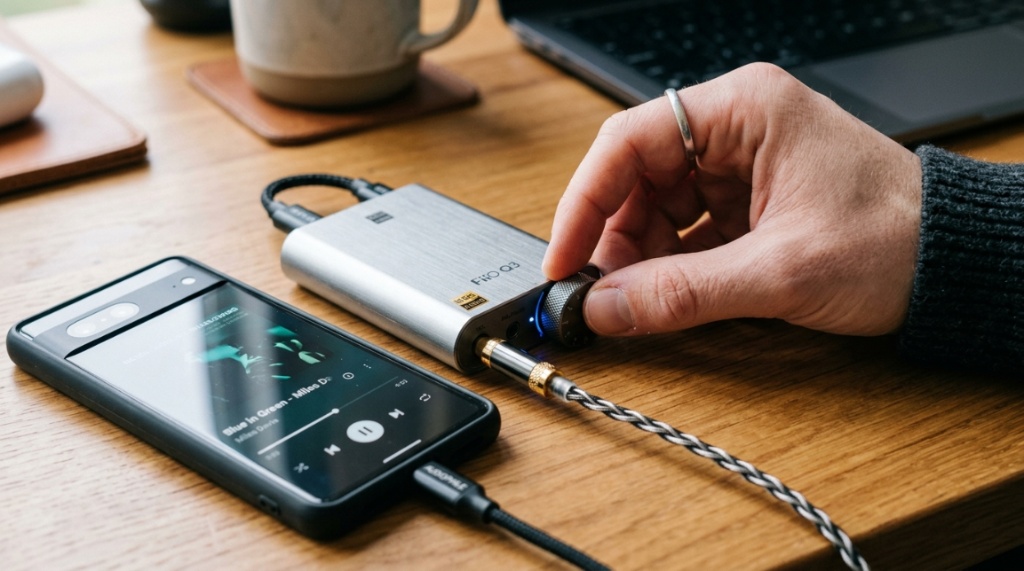
This is one of the most common questions budget buyers face. A stack (separate DAC and amp) offers maximum flexibility and upgrade paths, but it costs more and takes up more space. A combo unit (like the Fiio K5 Pro, Topping DX3 Pro+, or the iFi Zen DAC V2) combines both functions in a single chassis, saving money and desk space.
For most budget buyers, a combo unit is the smarter choice. You get a clean DAC that connects via USB to your computer, and the amp section is optimized for the internal DAC. The cost savings of a combo (usually 30–40% less than separates) can go toward better headphones. The downside is that if you want to upgrade the DAC later, you’re stuck replacing the whole unit. But on a budget, this trade-off is acceptable.
One key consideration: if your only source is vinyl or a CD player with no digital output, skip the DAC entirely and buy a dedicated amp. Don’t pay for a DAC you won’t use, Pair your home setup with portable gear for active use by exploring our top picks for the best running headphones in CA.
Common Budget Amp Mistakes to Avoid
Falling for marketing claims and unnecessary features is the fastest way to waste money on a budget amp. Here are the most common pitfalls:
- Overspending on “premium” op-amps: Budget amps with swappable op-amps are a gimmick unless you’re building or modding gear yourself. The stock configuration is almost always well-optimized.
- Ignoring gain settings: If an amp only has high gain, low-sensitivity IEMs will hiss. Look for adjustable gain switches (low/medium/high) to prevent background noise.
- Buying a tube amp under $150: Budget tube amps (like the FX-Audio Tube-01) are mostly coloration boxes, not true amplifiers. They add a “warm” tone, but they don’t provide sufficient power for demanding headphones. If you want tube sound on a budget, buy a hybrid tube amp (tube preamp, solid-state output) like the Loxjie A30.
- Forgetting about the source: If your phone’s headphone jack is already noisy or distorted, an amp will amplify that noise. You need a DAC in the chain to clean the signal first. If you’re using Bluetooth, realize that you’re already compressing the audio before it even reaches the amp.
- Choosing purely based on wattage: A 2W amp at 32 ohms might sound worse than a 500mW amp at 32 ohms if the higher-powered amp has poor channel separation or high THD (total harmonic distortion). Look for THD below 0.01% and channel separation above 70dB at 1kHz.
Budget Recommendation Tiers
To give you a concrete starting point, here are three tiers of budget amps that represent the best value at their respective price points. These are general recommendations based on established market reviews and community consensus, not personal testing claims.
| Tier | Budget Range | Best Options | Best For |
|---|---|---|---|
| Entry Portable | $30–$70 | Fiio A3, Tempotec Sonata HD II, QKZ DM7 Dongle | Phone listeners with low/mid-impedance headphones |
| Budget Desktop | $100–$150 | Schiit Magni+, JDS Labs Atom Amp | Home listeners with a dedicated computer source |
| DAC/Amp Combo | $150–$200 | Fiio K5 Pro, Topping DX3 Pro+, iFi Zen DAC V2 | Those who need a one-box solution with USB/optical inputs |
These tiers are not absolute rules. If you find a used higher-tier amp within your budget, that’s usually a better deal than buying a new entry-level unit. For example, a used Schiit Modi/Magni stack at $120 beats a new Fiio E10K at $75 in nearly every measurable way.
Frequently Asked Questions
Can I use a headphone amp with Bluetooth headphones?
No. Bluetooth headphones have a built-in amplifier, DAC, and battery. A separate headphone amp only works with wired headphones that connect via a 3.5mm jack, 6.35mm jack, or XLR connector. If you want better sound from Bluetooth headphones, upgrade the headphones themselves or use a lossless Bluetooth codec (like LDAC) with a high-quality source device.
Do I need a headphone amp if my headphones are only 32 ohms?
Not necessarily. Many 32-ohm headphones are sensitive enough to reach reasonable volumes from a phone or computer. You only need an amp if you hear distortion at high volumes, if the bass sounds weak and uncontrolled, or if you just want the cleaner sound that a dedicated amp provides. Try your headphones directly first; if they get loud enough without obvious distortion, save your money.
What does “gain” mean on a headphone amp?
Gain is the amount of amplification applied to the input signal. Low gain keeps the signal cleaner at lower volumes and is meant for sensitive headphones. High gain boosts the signal significantly for harder-to-drive headphones. A good rule: use the lowest gain setting where you can still reach your desired volume, because higher gain also amplifies background noise and hiss.
Is a balanced connection worth it on a budget amp?
Balanced connections (using 2.5mm TRRS or 4.4mm Pentaconn jacks) provide more power and better channel separation, but only if the entire chain (from DAC through amp) is balanced. On budget amps under $200, “balanced” is often a marketing feature with minimal real-world benefit because the internal circuitry isn’t truly differential. Spend your money on better headphones first.
How do I know if an amp is powerful enough for my headphones?
Multiply your headphone’s sensitivity (in dB/mW) by the amp’s power output (in mW). For example, if your headphones have a sensitivity of 98 dB/mW and an impedance of 32 ohms, and the amp delivers 100 mW, you get approximately 98 + 20 (log of 100) = 98 + 20 = 118 dB max volume. Anything above 110 dB is more than enough, as most listeners listen between 75 and 90 dB.
Conclusion
Buying a headphone amplifier on a budget in Texas doesn’t require compromising on sound quality—it requires understanding what to prioritize and where to look. Focus on power output that matches your headphone’s impedance and sensitivity, choose between portable and desktop based on your listening habits, and take advantage of local retailers and used markets to stretch your dollar further. Start with a solid desktop amp in the $100–$150 range if you listen at home, or a portable unit under $70 for travel and office use. Avoid common pitfalls like chasing high wattage figures or falling for marketing gimmicks like swappable op-amps. Your next step is simple: check your headphone specs, set a realistic budget around $100–$200, and start comparing amps based on the criteria outlined above. The right amplifier will make your headphones sound better than you ever thought possible for the price.